Imagining the Missing Layer of Organizational Awareness
In an earlier piece, I argued that GenAI’s greatest organizational contribution may be a layer of awareness organizations have never had — one that illuminates the dark corners no individual can hold in working memory. I attached a condition: GenAI performs most reliably when its context is bounded by a finite corpus of information with sound provenance.
But a curated corpus only determines what the AI may read — the plans, memos, minutes, and reports an organization already produces. It cannot tell the AI, or anyone else, what any of it means. Meaning requires a reference. Your phone’s location history can record every turn you took last quarter, faithfully, and still say nothing about whether any of those turns took you where you meant to go. For that, you need the destination.
For an organization, one question hangs over any piece of work: is this still taking us where we meant to go? That is a question of alignment. And to answer it, I’ve come to believe you need not one reference, but three — and they are not interchangeable.
Vision is the direction. What the organization exists to move toward, stated in language meant to outlast this year’s plan. It changes rarely — and when it does, every route and every test beneath it is due for a re-reading.
Strategy is the route. How the organization intends to make progress given what is true right now — the bets, the sequencing, the trade-offs. It changes more often than the vision, because the terrain changes more often than the destination.
The operating leader’s validation tests define what counts as evidence. These are what the operating leader — the person accountable for the outcome but separate from its execution — would accept as evidence of progress, in their own words. In the earlier piece I noted that GenAI’s findings need dependable validation checkpoints, with humans retaining the final judgment. This is that idea promoted from caveat to structure: the tests don’t confirm a reading after the fact; they are the third reference the reading is taken against. To safeguard against gaming or vanity metrics, some of the specific signals these tests probe for may need to remain private.
Of the three, the third is the one I see written down least often. Some organizations do run on that discipline — and it shows. In most I’ve encountered, it stays implicit — which is strange, because the evidence it governs is everywhere. A sales team hears the same objection for the third month running. An implementation team’s workaround is quietly becoming the real process. A product team watches adoption climb while repeat use stays flat. A service team notices that the cases everyone calls exceptions now make up a meaningful share of the work. None of these is merely an update to be summarized; each is a test of the strategy, arriving unlabeled. When the operating leader has written down in advance what evidence they would accept, signals like these have somewhere to land. When no one has, they tend to dissolve into status-report prose.
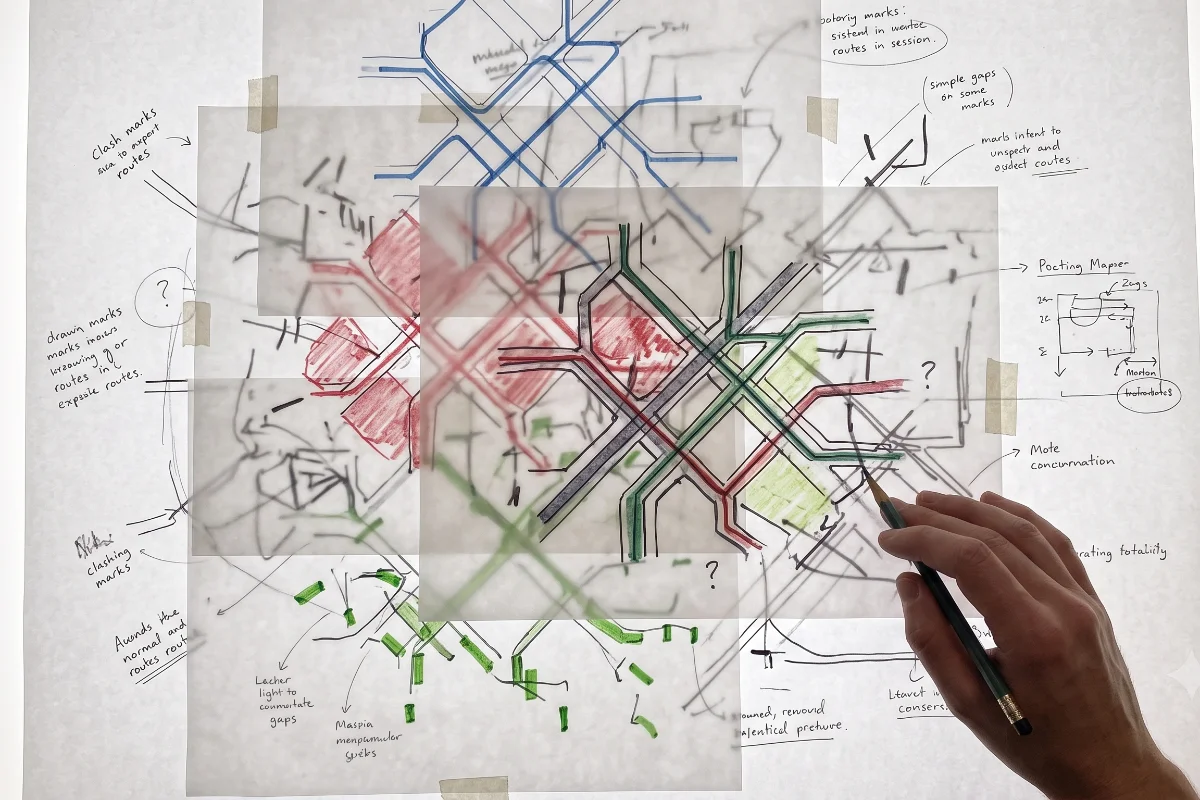
Here is why three matters. The everyday name for it is triangulation, and the example is in your pocket. The blue dot on your phone’s map comes from satellites — and no single satellite can produce it. One satellite only narrows the possibilities; it takes several, considered together, to locate the receiver. Locating what an organization actually intends works the same way. Give the AI the vision alone and you have given it one satellite: almost anything can be justified against a vision; most visions are written to be roomy. Add the strategy and the picture narrows — though a route can quietly outlive its destination. Add the validation tests and it narrows again. Together, the three pin down intent precisely enough that drift has something to show against.
And there is a practical relief hiding in that: the three references form a standing frame. The reports and minutes still flow through as the material being read — but what the organization intends never has to be reconstructed, prompt by prompt. The frame is set once, from documents the organization already maintains, and revised only when intent itself is revised. The corpus bounds what the AI reads; the references bound what it means.
A position, though, is only true for the moment it was computed. The organization keeps moving — which is why the blue dot never stops updating, and why this reading cannot be a one-time audit.
And when a piece of work strains against that position, I’ve learned to treat the tension not as noise, but as the signal.
The tensions have recognizable shapes — though each is a hypothesis to investigate, never a verdict. Work that conforms to strategy but has drifted from vision may mean the route survived a change of destination — or that the vision is written too loosely to steer by. Work that passes every validation test while tracing to neither vision nor strategy may mean the organization is still measuring something that stopped mattering. Which explanation is right is for people to work out. All the AI does is raise the question — one it can examine more meaningfully with all three references in view, because an artifact that appears sound against one may strain against another.
There is a failure mode worth naming, because it is also the method’s first finding. A second satellite only helps if it sits in a different part of the sky — GPS engineers call the bunched-together case a dilution of precision. If your strategy merely restates your vision in more words — same claims, longer sentences — you don’t have two references; you have one, written twice, and the context is no narrower for it. The same goes for validation tests that recite the strategy’s milestones back to it. When that happens, the exercise fails informatively: before this method tells you anything about your artifacts, it tells you whether your references are distinct enough to navigate by. I suspect many organizations would discover the answer is no — a discovery worth having on its own.
One caution, and it matters. Work that sits comfortably inside all three references does not mean the organization is right. All three can be wrong together — they are often written by the same few people, and they carry the same blind spots. This method tests internal alignment. Whether the intent itself is sound still has to be answered against customers, conditions, and consequences — and no reading of your own documents can answer that for you.
Here is why I think this matters more with every layer of growth — a pattern I’ve watched play out in organizations of nearly every size. Except in the earliest startups, layers of people sit between vision, strategy, and execution. The signals I described earlier — the repeated objection, the workaround becoming the process — travel through those layers at the pace of human deliberation: someone notices, someone summarizes, someone escalates, someone decides. The feedback loop closes in days when you’re lucky; more often in weeks, quarters, sometimes years. The result, more often than not: the bigger an organization grows, the slower it responds to its own ground realities — and to the market shifting underneath it. Some organizations fight that drag far better than others, but the drag is structural — even the best-run pay something for it.
Now imagine the three-reference reading running against the material that already flows — every tactical status report, every set of meeting minutes, read as it lands inside that same standing frame. Each cycle surfacing what appears to be working, what may need refinement, and what may be pointing at a change of direction — every flag linked back to the artifacts that raised it. Not deciding any of it — the caution above stands. But shrinking the distance between something happening on the ground and someone accountable seeing it. A loop that today closes in quarters could close in reporting cycles — the position refreshing as the organization moves, instead of an annual guess at where you are.
Notice what this asks of the technology, and what it doesn’t. Humans author all three references. Humans keep the verdict on every gap that surfaces. What GenAI contributes is the ability to hold all three in view across a volume of material no operating leader could read on any regular cadence — every artifact, every cycle. Not perfectly: these systems can miss things and misweight things, which is why the human verdict is not a formality but part of the design. The judgment stays where it belongs. The reach of the reading is what’s new.
This remains a working hypothesis — part of a framework I’m developing and intend to test, not a conclusion I’m defending. But it reframes a question I hear often. Organizations ask whether their data is ready for AI. Fewer ask whether their references are ready — whether vision, strategy, and validation tests are distinct enough, and clear enough, to navigate by.
And you don’t have to take my word for any of it. Here is a homework assignment.
Pick the project. One you’re running right now that involves at least two teams — ten to fifteen people — ideally one where alignment already feels hard, where refining the strategy is a recurring argument. Treat the past one to three months of its own reporting as your baseline.
Write the references down first. The vision language this initiative answers to, the current strategy for it, and — before you go further — what the operating leader (the person accountable for the outcome but separate from its execution) would accept as evidence of progress, in their own words. Those three documents become the standing frame for every reading; if you later find yourself re-explaining what the initiative is for each time you ask, treat that as a finding about your references.
Run the reading in parallel. Change nothing else about how you work. Each reporting cycle, have an AI assistant of your choice read the new status reports and meeting minutes inside that standing frame and flag whatever strains against any of the three references — every flag pointing back to the material that raised it. Give one accountable person the job of reviewing the flags — many will be noise, some will be things you already knew — and bringing the ones worth discussing into the deliberations you already hold. Without that named owner, the flags risk becoming one more queue nobody is responsible for; with one, they become agenda items. Adjust as you see fit.
Compare — honestly. After one to three months, weigh the new period against your baseline, but be clear about what a comparison like this can prove. It isn’t a controlled experiment; the act of paying attention changes things all by itself. The readout that matters is simpler: did the reading surface anything real that you didn’t already know? Did anything it flagged change a decision? Would you have caught it later — or not at all?
If you run it, I would genuinely like to hear what it helped you see — and what it missed. Especially if the answer is nothing: that’s evidence too, and I mean it when I say this is a hypothesis under test.